Author: Matt Anton

Basic Circular Saw Blade Types, Teeth Patterns and Uses

Circular Saw Blade Diagram

Every workshop must be fitted with a wide variety of tools to accomplish any task thrown a craftsman’s way. One of the most widely used and common tools that can be found in almost any workspace is the abrasive circular saw. As time has progressed and technology has increased, the need to cut a multitude of materials has risen in response. Now, industry members have the ability to choose the exact saw and blade to give the operator the precise finish they desire.

In today’s market, there are over 47 different types of saws! Our personal favorite, the vertical panel saw offers a wide range of benefits that outshines others in terms of productivity, function, and overall versatility. Panel saws are a vital tool for Cabinet Makers, Sign Shops, Shipping and Crating Service Providers, Flooring Contractors, Builders, and any craftsman/operator needing to cut large sheets of a material into smaller pieces/sections. With a Saw Trax panel saw even small strips can be cut from the large sheet goods which is only one aspect of our panel saws that stands apart from the rest. Rest assured knowing your Saw Trax panel saw will arrive squared, and with our patented Accu-Square system you should never lose that perfect alignment. Our alignment system has been a shining star in terms of customer satisfaction.

With the Saw Trax Rotating Insert Plate, operators are able to set up multiple tools ahead of time. With the needed tools set and ready, the operator can take advantage of the 8 second tool change by quickly swapping out the tool plate with the tool attached, reducing the need to change the blade itself in-between cuts. The Rotating Insert Plate also allows the operator to cut their materials in both vertical AND horizontal directions, a feature that provides extreme convenience and a favorite among users.

But what about the blades!? It may seem like a daunting task when trying to decide which blade is right for the job. With the massive amounts of different types, different teeth, different material FOR different materials, it can become quit confusing to know exactly which blade is best suited for the task at hand. Let’s take a look at the four basic types of circular saw blades and learn which is the optimal choice for what applications! Reader stay tuned and be sure to check back later for an deeper dive when we break down these basic types of blades further in upcoming blog posts! But first, let’s define some basic vocabulary so the information below is as easy to absorb as possible…

Circular Saw Blade Diagram

Bore : The bore of the circular saw blade is the center circle that allows the blade to be attached to the saw via the saw’s arbor (the shaft that allows the blade to be secured in position and locked into place).

Kerf : refers to the thickness of the slot which the saw blade will cut. It is often used as well to define the thickness of the blade itself, or at least the widest point of the blade, as this will define the width of the cut made.

Teeth : The outside points of a blade that do the work cutting the material. There are many different types of teeth that give the user a different type of cut. Generally, the more teeth the blade has the smoother the cut will be, and likewise, the fewer teeth the blade has will cause the blade to remove more material giving a rougher cut.

Gullet : The curved area at the base of the tooth. The tooth tip to the bottom of the gullet is the gullet depth.

Expansion Slot : Used primarily on larger diameter blades and functions to create an outlet for heat buildup created during cutting. A steel blade will heat up to a point where the heat is great

Shoulder : The part of the blade body directly behind each tooth that provides support for each tooth. The shoulder’s major function is to provide strength and support to the tip of the tooth. A well designed blade allows the shoulder to provide extra strength and helps guide the tip through the material the operator is cutting.

Hook Tooth Angle : The amount of lean to the blades teeth, and the angle the teeth will engage with the material being cut.

Negative Hook Angle: Negative angles are blade teeth that have a backward lean. Negative hook angle blades are more appropriate for cross cutting cuts, and are better suited for plywood and non-wood materials such as plastics as well as metal.

Positive Hook Angle : In contrast to Negative Hook Angle, Positive Hook Angle refers to blade teeth that have a forward lean. Positive hook angles are generally used on rip blades to help pull the wood into the blade. For harder materials, the angle needs to be a smaller degree with less steepness. The higher the value the angle goes, corresponds to softer materials.

Crosscut : cuts that run across, perpendicular, the grain of the material such as wood.

Rip Cut : cuts that run along the grain, parallel, of the material such as wood.

Rake : another word for hook angle. The rake of the blades teeth affects the tendency of material to move during cutting. Positive rake helps move the material “into” the blade, in other words, helps the blade self feed. A negative rake is less aggressive and does not help force the material towards the blade.


The Four Basic Types of Circular Saw Blades:

FTG Blades – Flat Top Grind : FTG Blades have teeth with the top edges square to the saw plate. These flat top teeth work by attacking the wood like a chisel, chopping the wood. This blade style produces very fast cuts while the blade itself remains very durable; however, these types of blades do not produce a very clean cut, leaving the surface unsmooth. FTG blades are designed for Rip cuts, or cutting WITH the grain.
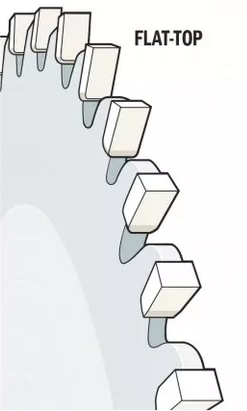
FTG FTG Pattern


ATB Blades – Alternate Top Bevel : ATB blades have teeth that are angled across the top edge. Every other tooth is angled the opposite direction from the previous tooth. The shape of the teeth gives a clean tear through the material. The steeper the angle of the teeth, the cleaner the cut the blade produces, however; this allows the blade to dull faster the steeper the angle gets. Most ATB blades are considered “general purpose,” and usually have at least 40 teeth.
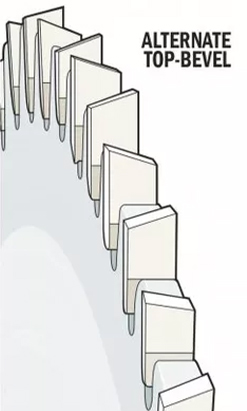
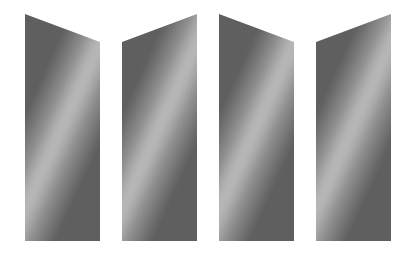
ATB ATB Pattern


Combination ATBR : Standard combination blades are made up of sets of 5 teeth (4 ATB, or angled teeth, followed by a raker tooth (squared top). The ATB teeth are made to produce smooth, clean cuts while the Ranker tooth aids with Rip Cuts. Combination blades are also considered to be an “all-purpose” blade.
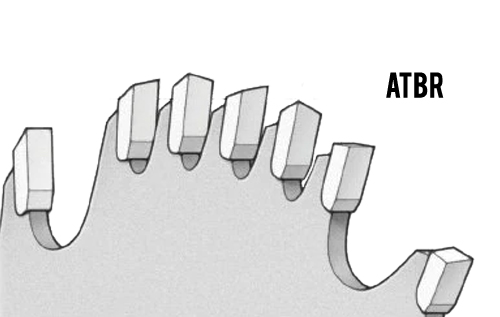
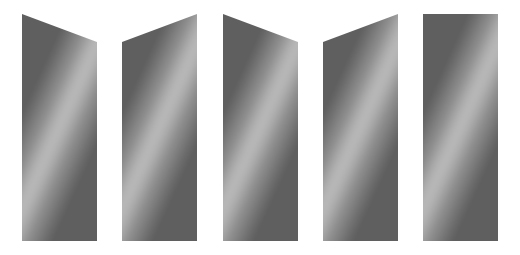
ATBR ATBR Patterns


Triple-Chip Grind (TCG) : TCG blades consists of alternating teeth. Each tooth alternates between angled and squared. Each ATB (angled or chamfered) tooth chisels the cut while the ranker tooth follows behind to clean the roughness. TCG type blades are primarily used on dense materials such as laminated plastic, Corian, and metals like brass and aluminum.
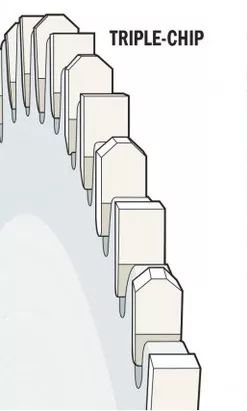
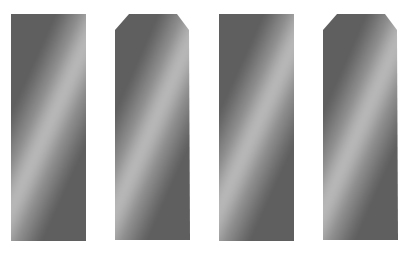
TCG TCG Pattern

Don’t forget to check back in when we take a deeper dive into blade types and expand on what saw blades are best suited for different materials!

Continue Reading
The Evolution of Signage and Why Versatility for Sign Makers Matters

5443431109 F249407766 B 300x200

The Evolution of Signage and Why Versatility for Sign Makers Matters


In honor of the International Sign Expo 2021 – Virtual that was kicked off yesterday, Wednesday, April 7, 2021, the Saw Trax team would like to pay homage to our friends and partners within the sign industry! In today’s world, anyone can take a stroll down the street and within minutes encounter a multitude of colors, shapes, sizes and even lights galore. If a business has a brick-and-mortar establishment, it is pertinent for that business to have a well displayed sign that is easy to read. The sign serves multiple purposes such as displaying a company’s name and contact information, allows consumers to easily locate the establishment, creates interest from potential new customers; honestly, the list is endless!

With the abundance of signs and graphic displays that seem to flood the streets and every corner in today’s market, it is difficult to envision a time without such advertisements. After a quick look at the overall history of sign making it may be surprising to learn that a time without outdoor signs goes back farther than many may believe! Historians have evidence of the earliest signs dating back to an amazing 3000 BC and experienced great strides in advancements up to approximately 500 AD. Usually depicting a single image to convey the messages, these ancient signs were originally made from wood, stone, leather, and even terra cotta.

ancient civilization carvings used as signage
Ancient Civilizations Used Carvings to Act as Signage Well Before Literacy was Common

After the Dark Ages came a time of prosper while the economy rebuilt. By time the 17th Century came around materials like iron, wood and textiles were common in sign making. Signs were still being made with an image or symbol as opposed to including text; however, signs featuring single letters were beginning to be found. As the times progressed, signs became more and more wordy allowing the business to convey more information to any passerby.

1768 151x300 1802 189x300 1777 211x300 1773 191x300

The first gas illuminated signs were not made until 1840, well into the 19th Century, and manufactured in Chicago for the Barnum Museum. These newly created bulbs were a part of the first electric signs and were able to illuminate, for a whopping, 5 straight hours! The use of gas illuminated bulbs exploded across the US. Storefronts such as retail stores, theaters and banks were popular establishments well known for displaying these early signs.

Great Chariot Race Illuminated Sign

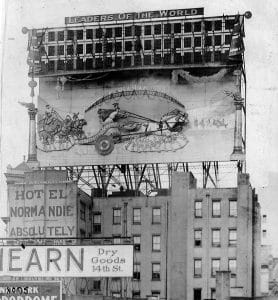
Roughly 40 years later came the introduction of incandescent bulbs. These types of light bulbs are common in many homes and offices even in today’s world. America took to the forefront with the first designs of “night display” signage that used these new incandescent bulbs that took sign making to a new level. As the use of these types of signs surged, it became more evident that this type of advertising was much more effective than newspapers and the like. In 1910, the most famous sign in all the world called New York City home and proudly displayed 20,000+ lights in different colors that would flash to give the horses the appearance of running. That infamous sign would be known as the Great Chariot Race Sign. A truly remarkable invention to say the least!

Great Chariot Race Sign

The sign industry kept growing and saw the likes of neon tube and fluorescent tube lights. With less and less restrictions as innovations progressed, the finding of plastics seemingly relinquished them all. Manufacturing improved and quality thrived all while the costs remained effective and profitable. The best part, since plastic is so versatile, it could be incorporated with any type of bulb to produce much more complex signs. Acrylics surged in popularity and virtually every business/organization had an acrylic sign whether it be with or without illumination… they were simply used everywhere!

Bespoke Signage Famous Signs Blog Image 300x180 Vegas 2 300x199 Parking 1 234x300 Microsoft Signage 300x142

In today’s age and time, sign making has never been perfected more. Shops utilize a host of different materials ranging from Dibond, Foamboard, PVC, Acrylics and so much more. To take advantage of these materials, it is imperative for sign makers to have the correct tools on hand that is sure to give a precision cut every time, no matter the material, no matter the thickness, and any limitations must be negated. Saw Trax wanted to give all sign makers the ability to work with any material they see fit for their design by creating The Sign Maker’s Series Vertical Panel Saw.

Saw Trax Sign Maker's Series Vertical Panel Saw with Substrate Cutter
The most versatile panel saw and substrate cutter all-in-one Sign Maker’s Series Vertical Panel Saw

The Sign Maker’s Series Vertical Panel Saw puts just as much versatility into the designer’s hands as the material itself. Quickly, and effortlessly, release the tool insert plate which allows for the fastest tool change possible. The insert tool plates include different substrate cutting tools, the best in their class, such as an ACM cutter and OLFA Knife, as well as a “blank” plate that is compatible with most 7-1/4” saws.

Acm Edt 2 300x225 P 8561 Panel Saw Signmaker Series Full Size Vertical Panel Saw 8 300x258 Blank Universal Plate 300x300 Floating Router Insert 300x252 Glass Cutter E1442093374403 300x300

Sign Makers are designing, creating, cutting, building signs indoors which justifies a dire need to keep a handle on all the dust an average machine/saw will produce. The Saw Trax Sign Maker’s Series Vertical Panel Sawn is far from average and includes our very own dust collection system! Not only does the saw pull the dust and debris but also includes a medium coarse brush around the blade that cleans as it cuts. With each pass, the brush gives the rip or cut a clean sweep every time. Talk about convenience removing the need for extra cleanup after the job is done.

Spinning Gif 1 300x225

The most amazing, stand apart aspect that sets a Saw Trax machine apart from the competition is our patented spinning plate mechanism that allows the user to cut in both directions horizontally and vertically! Named the most accurate of the panel saws, each Saw Trax Vertical Panel Saw will remove limitations giving your shop the versatility the materials expect. This all-in-one tool makes leaps and bounds in terms of space saving! You will never need multiple machines to cut different materials just to complete one job. We took the design of the panel saw to the next level to give each user results that are not only time saving but material saving as well. One thing is for sure, if it’s not a Saw Trax, it just doesn’t cut it!

Continue Reading