Moving a normal box with a hand truck is straightforward. Moving a large door unit, window assembly, staircase, prefabricated wall section, cabinet, crate, or other oversized load is a completely different material-handling problem.
The challenge is not always the weight.
Sometimes the biggest problem is that the load is so wide or tall that the person moving it cannot see where they are going.
That leads to an important question for safety managers, warehouse supervisors, manufacturers, millwork operations, and distribution centers:
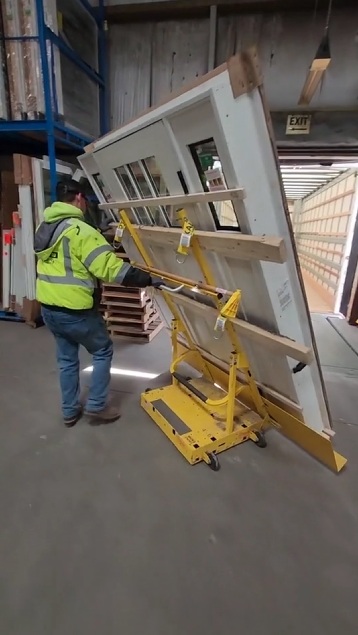
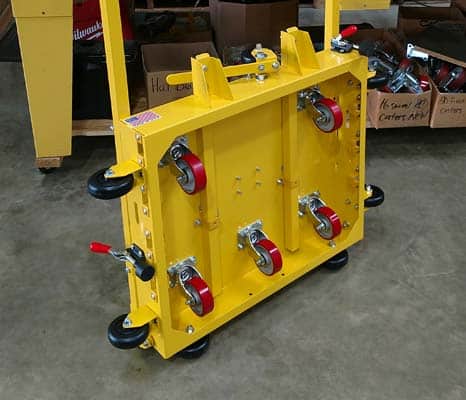
The Saw Trax Scoop Dolly was developed specifically for these difficult loads. Rather than functioning like a conventional two-wheel hand truck, it combines a pivoting scoop-style loading system with four swivel casters that allow the load to move in virtually any direction.
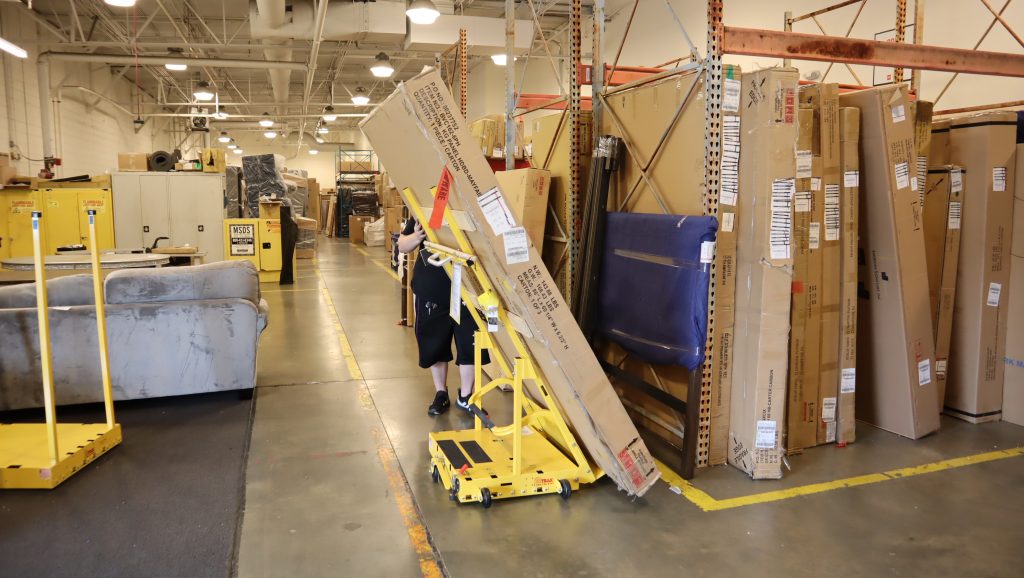
That ability to move sideways changes how an operator can approach a wide-load move.
A Wide Load Creates a Visibility Problem
Look at what happens when a large boxed door or similar product is placed on a traditional hand truck.
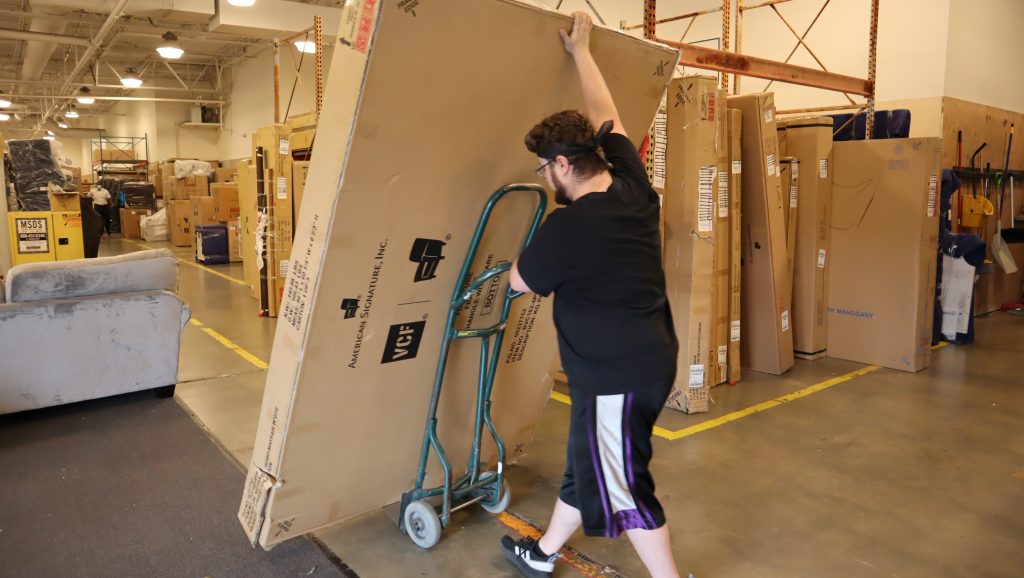
The load can completely occupy the operator’s forward field of view. If the worker pushes the hand truck forward, the product is between the worker and the travel path. The operator may not have a clear view of a rack upright, another cart, stored inventory, a doorway, a coworker, or another obstacle until the load is already close to it.
The obvious alternative is to turn around and pull the load while walking backwards.
That solves one problem but creates another.
Now the worker can see the load and some of the area around it, but the employee is walking backwards while controlling a tall, heavy object. In a real warehouse or manufacturing environment, that can mean backing toward floor transitions, equipment, pallets, corners, workstations, or other traffic.
Neither approach is particularly appealing:
- Push forward: the load may block the operator’s view.
- Pull backward: the operator may be walking in the direction they cannot continuously see.
- Repeatedly stop and look around the load: visibility improves, but the move becomes slower and requires constant repositioning.
With oversized material, visibility should be considered part of the material-handling problem itself.
The Third Option: Move the Load Sideways
The Scoop Dolly introduces another option because it is supported by omnidirectional swivel casters rather than two fixed-direction wheels.
The operator can position themselves beside the load and move it laterally.
Instead of being forced to stand directly behind a large door or window assembly, the worker can choose a position that provides a better view of the travel path and maneuver the dolly from there.
This can be especially useful when moving:
- Prehung doors and door assemblies
- Large windows and window units
- French doors and doors with sidelights
- Staircases
- Large cabinets and millwork
- Prefabricated wall sections
- Large crates
- Bulky boxed furniture
- Industrial equipment and machinery
- Other long, tall, or unusually wide objects
The ability to move sideways also helps in areas where a conventional hand truck would require repeated backing, turning, and repositioning. A worker can make smaller directional adjustments while navigating around warehouse racks, machinery, staging areas, workbenches, and other obstacles.
For operations that routinely handle awkward materials, that difference can be more important than simply adding another set of wheels.
Why Conventional Hand Trucks Can Be Awkward With Oversized Loads
A conventional two-wheel hand truck generally wants to travel in the direction its wheels are pointed. Turning a large object therefore requires the operator to rotate the entire load around the wheel axle.
That works well when the object is compact.
With a door, window unit, large crate, or staircase, however, the load itself may have a much larger turning radius than the dolly. Even when the wheels clear an obstacle, the far end of the product may swing into a rack, wall, doorway, piece of equipment, or adjacent product.
The employee may also be responsible for several things at once:
- Prehung doors and heavy door assemblies
- Large windows and window units
- French doors and doors with sidelights
- Staircases and other tall, awkward loads
- Large cabinets, millwork and prefabricated sections
- Long or unusually wide objects
- Large crates
- Bulky boxed furniture
- Industrial equipment and machinery
That is a lot to ask from one operator.
The broader Saw Trax lineup of industrial carts and dollies for oversized material handling is designed around these kinds of real-world handling challenges rather than treating every load like a pallet or cardboard box.
The Scoop Dolly Keeps the Casters on the Floor While Loading
Maneuverability is only part of the design.
The Scoop Dolly also approaches loading differently from many traditional door dollies.
Its scoop section pivots independently from the main dolly body. The operator can position the scoop lip under the load while the main dolly remains flat on the floor. The object is then tilted back onto the support structure using leverage.
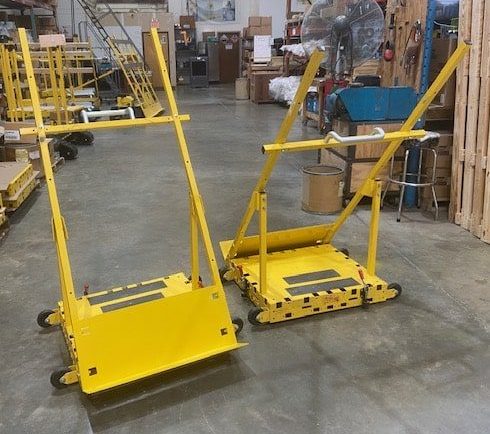
That distinction matters because the worker is not required to lift an entire wheeled platform and product together just to get the load into its transport position.
Once positioned, the Scoop Dolly’s adjustable support system allows the angle of the load to be changed so that different sizes and shapes can be carried with the center of gravity positioned over the dolly.
The standard unit is built from welded 12-gauge steel and is rated for an 800-pound load, with a Scoop Dolly 1,000-pound weight capacity upgrade available for heavier applications.
It Was Originally Designed to Solve Saw Trax’s Own Material-Handling Problem
The Scoop Dolly was not created as a theoretical exercise.
Saw Trax originally needed a better way to move its own crated vertical panel saws. Those machines could be approximately 10 feet long, 94 inches tall, and weigh roughly 500 pounds when crated.
The previous process could involve a forklift operator and another employee positioned at the far end of the load to help guide or steady it.
That created the type of coordination problem familiar to many manufacturing facilities: one person operating powered equipment while another person works close to a large, difficult-to-handle object.
The resulting Scoop Dolly concept was refined into a material-handling system for other large products such as doors, windows, stairs, prefabricated assemblies, furniture, and industrial loads.
That history helps explain why the dolly looks different from a conventional hand truck. It was designed around an unusually large load from the beginning.
Wide Loads Need Support Across Their Width
Sideways movement is most useful when the load itself is properly supported.
For applications involving extra-wide windows, doors, crates, cabinet assemblies, or similar products, Saw Trax offers a Scoop Dolly Horizontal Support Extension.

The system allows the support boards to extend outward, providing support across loads approximately eight feet wide or more while retaining the compact footprint of the dolly when the additional width is not needed.
This is particularly relevant for operations where the load extends substantially beyond the base of the dolly. The objective is not simply to get wheels underneath the object; it is to support the load in a way that makes it controllable while it is being moved.
Double Windows and Sidelighted Doors Need an Even Wider Loading Surface
Some millwork products present another problem: the point where the load contacts the dolly may itself be unusually wide.
A double window, French door, or entry door with sidelights can extend well beyond a standard loading lip.
For those applications, the 72-inch Scoop Dolly Lip creates a much wider loading surface. The additional width is designed to provide more support for oversized door and window assemblies rather than concentrating the load on a relatively narrow section of the product.
This is an important distinction between simply finding a cart that can carry the weight and configuring a material-handling system for the actual dimensions of the product.
Tall Loads Create a Different Center-of-Gravity Challenge
A wide load affects visibility. A tall load introduces another issue: leverage.
The farther the mass of an object extends upward, the more important the position of its center of gravity becomes during movement. A tall door assembly, wall panel, or window unit therefore needs adequate upper support.
The Scoop Dolly Vertical Extension Posts extend the vertical support beyond eight feet for loads that require additional support higher up the product.
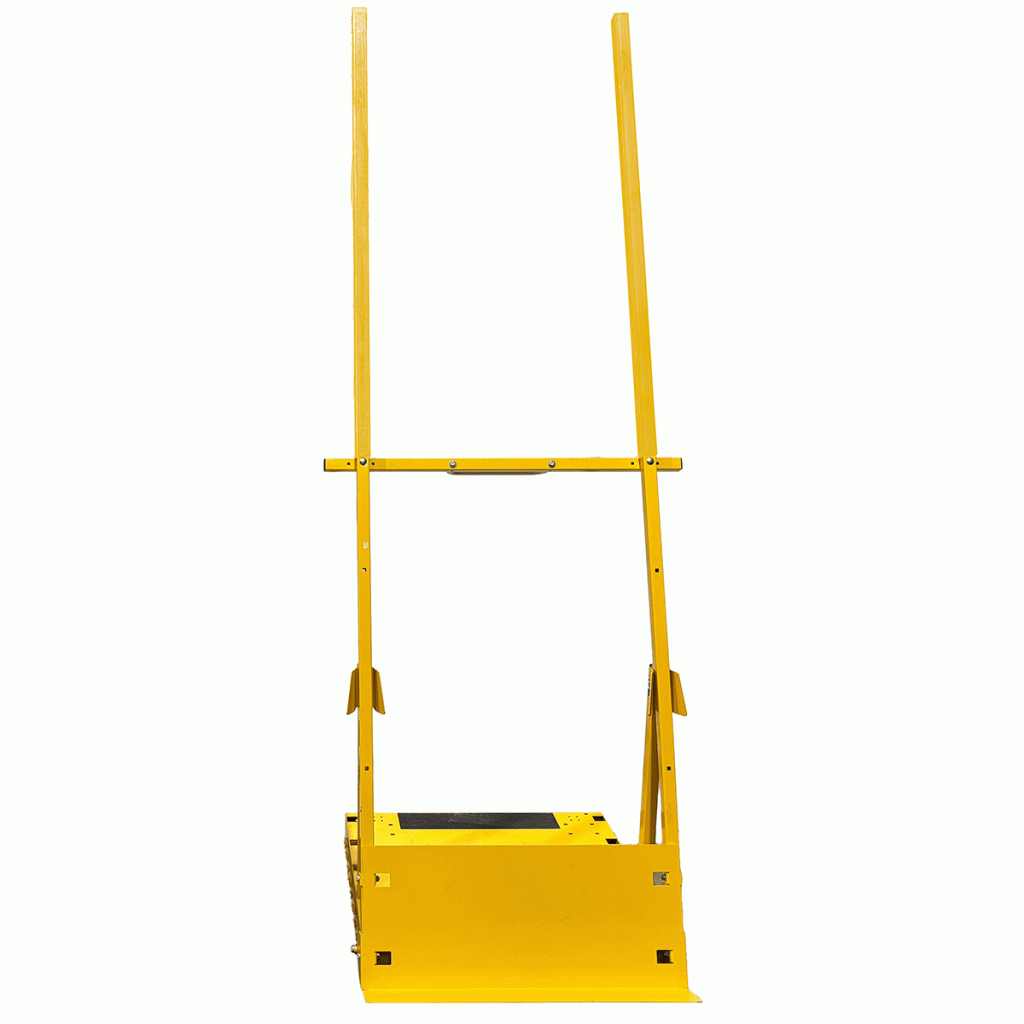
Saw Trax also offers outriggers for carts and dollies that expand the footprint of the Scoop Dolly. For unusually tall loads, a larger footprint provides more area in which the center of gravity can remain over the dolly.
Those accessories address two different dimensions of the same handling problem: support the product high enough and provide an appropriate footprint underneath it.
Sometimes You Want 360-Degree Movement. Sometimes You Want the Dolly to Track Straight.
One of the Scoop Dolly’s strengths is its all-caster design. It allows the operator to translate the load sideways, move diagonally, rotate it, and make precise adjustments in tight spaces.
But omnidirectional movement is not ideal for every part of every move.
Consider a long trip down a warehouse aisle. In that situation, the operator may not want four casters constantly free to swivel. They may want the dolly to track predictably in one direction.
Saw Trax developed the Scoop Dolly Directional Wheel for exactly that situation.
The Directional Wheel provides straight-line tracking so an operator can push the load forward rather than continually correcting caster drift. This gives a facility two different handling modes:
- Omnidirectional mode: useful for sideways movement, positioning, tight spaces, and precise maneuvering.
- Directional mode: useful for longer straight runs where the operator wants to push forward and keep their eyes on the travel path.
That means the answer is not that sideways movement is always better than forward movement.
The advantage is giving the operator the right type of movement for the situation.
What Happens at a Loading Dock?
A dolly that performs well on a smooth warehouse floor still has to deal with the transition between the building, dock plate, ramp, and trailer.
Small casters can encounter abrupt changes in elevation at these transitions. A heavily loaded cart can become more difficult to control when one set of wheels reaches the transition before the others.
The Dock Transition Wheel system adds strategically positioned wheels to help the dolly move across dock transitions and similar irregular surfaces.
For facilities that regularly move door units, windows, cabinets, or other bulky products between production, staging, and outbound trucks, it is worth evaluating the entire travel route rather than only the smoothest section of warehouse floor.
Loading the Product Can Be Just as Important as Moving It
Some tall or heavy products can be difficult to pull into their final position on a dolly. Saw Trax has developed accessories specifically for that part of the process.
The Shepherd’s Hook for the Scoop Dolly is designed to help secure and control tall products while they are being tilted and positioned. A foam-covered contact area helps protect finished products while the operator uses the hook to control the load.
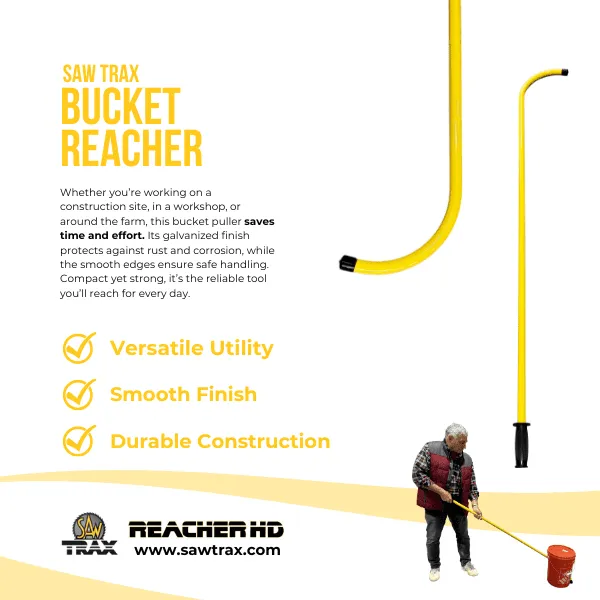
For another approach, the Heavy Duty Puller Pole gives the operator additional reach for pulling tall objects toward the Scoop Dolly during loading.
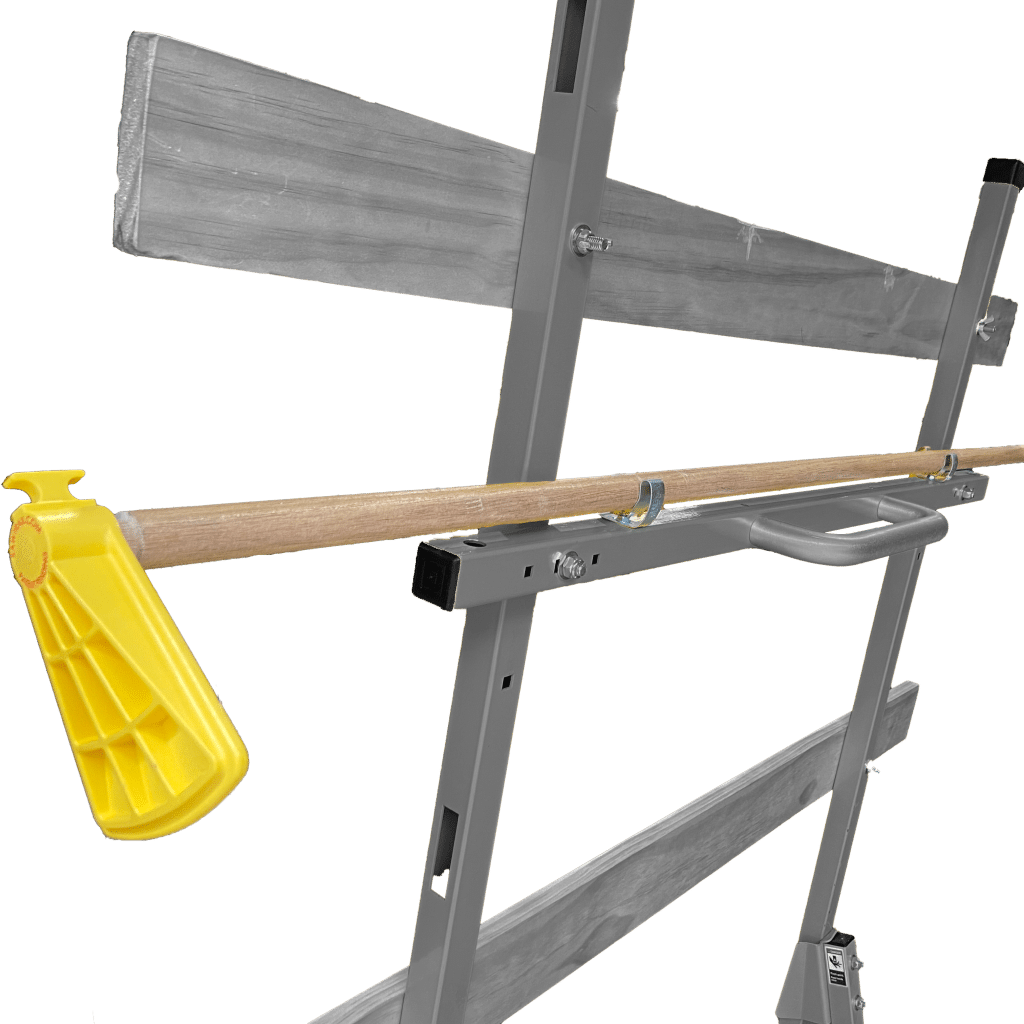
The principle is straightforward: if an awkward load is difficult to reach, give the worker a tool that provides reach and leverage rather than asking them to stretch, climb, or place themselves in an awkward position.
Indoor Warehouse Movement and Job-Site Movement Are Different Problems
The standard Scoop Dolly excels on the relatively hard, smooth surfaces found in warehouses, factories, showrooms, and distribution centers.
A construction site presents a very different environment.
Gravel, dirt, mud, rocks, unfinished entrances, slopes, and uneven ground require larger wheels and a wider, more terrain-oriented design.
For those environments, the Manual Job Site Scoop Dolly uses large flat-free tires, adjustable support positions, E-track securement points, and a footprint designed for moving doors, windows, panels, and other millwork across rough job-site surfaces.
For operations making frequent heavy deliveries over particularly difficult terrain, the Motorized Job Site Scoop Dolly adds a powered tracked drive system. It is designed for applications involving sand, mud, gravel, inclines, and other surfaces where manually moving a heavy load can require substantially more effort.
The takeaway is important: the right material-handling equipment depends not only on what you are carrying, but also on where you are carrying it.
Safety Managers Should Evaluate the Entire Move, Not Just the Load Rating
Load capacity is important, but a number on a specification sheet does not tell you how practical a cart will be in the workplace.
When evaluating equipment for wide or tall materials, consider the entire move:
- Can the operator see the travel path?
- Does the employee have to walk backwards?
- How much of the product extends beyond the cart?
- Can the load move sideways when clearance is limited?
- Can it turn without the far end swinging into an obstacle?
- How is the product loaded onto the cart?
- Does loading require lifting the product or the cart?
- Can the center of gravity be positioned over the dolly?
- Does the load need additional horizontal or vertical support?
- Will the route cross dock plates, thresholds, ramps, or uneven surfaces?
- Does a long straight run require directional tracking?
- Can the load be secured appropriately for the application?
Those questions reveal much more about the suitability of a dolly than capacity alone.
The Goal Is Not Just to Move the Product. It Is to Control the Move.
Oversized material forces employees to work differently.
A large door may block the view ahead. A tall window assembly may create leverage above the cart. A wide cabinet may need additional support. A staircase may have an awkward center of gravity. A dock plate may interrupt an otherwise smooth path.
A conventional hand truck may be able to carry the weight while still forcing the operator into an awkward position.
The Scoop Dolly takes a different approach:
- Load the product using a pivoting scoop rather than lifting the entire dolly.
- Adjust the angle of the load to better position its center of gravity.
- Move in any direction when maneuverability matters.
- Move sideways when standing behind the load would restrict visibility.
- Add directional tracking when a long forward push makes more sense.
- Expand horizontal, vertical, or ground support when the load requires it.
This is also consistent with the broader Saw Trax EMPOWER philosophy: use purpose-built material-handling equipment to help employees accomplish difficult moves with less unnecessary handling, fewer people tied up on the same task, and greater control over the product.
So How Is Your Team Moving Wide Loads?
The next time you see an employee moving a large door, window, crate, staircase, or other oversized object, pay attention to where the employee has to stand.
Are they behind the product with their view blocked?
Are they turned around and walking backwards?
Are they repeatedly stopping to peer around the side?
Are two employees being used because one person has to move while the other watches or guides?
Those may be signs that the problem is not the employee’s technique.
The material-handling equipment may be forcing the technique.
With an omnidirectional Scoop Dolly, the operator has another choice: position the load, stand where visibility and control are better, and move sideways when the situation calls for it.
Push blindly, walk backwards, or maneuver the load from where you can see.
For wide, tall, and awkward materials, that third option can make all the difference.
Continue Reading