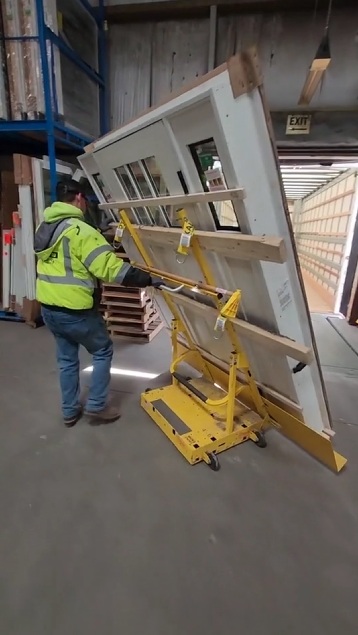
Moving a big quad door set presents a material handling problem that a standard hand truck or conventional door dolly was not designed to solve. A large multi-door assembly can be tall, wide, heavy and difficult to balance, especially when it needs to be moved through a manufacturing facility, warehouse, loading area or jobsite.
For large assembled door units such as a quad door set, the Saw Trax Scoop Dolly for moving large doors and oversized loads provides a practical way to load, support and maneuver the entire unit while reducing the lifting and manpower normally required to move it.
Instead of having workers carry the door set or wrestle it onto a conventional cart, the Scoop Dolly is designed to get underneath large loads and use leverage to bring them into a stable transport position.
Why Are Quad Door Sets So Difficult to Move?
A single door can already be awkward to handle. Put multiple doors together into one large framed assembly and the handling challenge increases considerably.
The issue is not simply weight. A quad door set combines several difficult characteristics:
- A large overall footprint
- Significant height and width
- A high or difficult-to-control center of gravity
- Finished components that need to be protected
- Limited places for workers to safely grip the assembly
- Difficulty maneuvering through aisles, doorways and production areas
Adding more employees can help distribute the weight, but it also means coordinating several people around one large object. Forklifts may be appropriate for some parts of the handling process, but they can be excessive or difficult to maneuver when the goal is simply moving an assembled door unit across a facility.
That combination of height, weight and awkward dimensions is exactly the type of material handling challenge the Scoop Dolly was developed to address.
How Does a Scoop Dolly Move a Large Door Set?

The Scoop Dolly works differently from a typical hand truck.
The dolly remains flat on its casters while the scoop portion is positioned beneath the load. The door unit can then be tilted back against the dolly’s vertical supports using leverage rather than requiring workers to lift the entire assembly onto a cart.
Once positioned, adjustable tilt settings allow the operator to change the angle of the load and help keep its center of gravity over the dolly. This is particularly useful with tall objects such as door and window assemblies.
Saw Trax originally developed the Scoop Dolly to move its own large crated panel saws. That same basic concept has since been applied to fully framed doors, windows, staircases, prefabricated wall sections and other large objects that can be difficult to handle with conventional carts.
See a Large Quad Door Set Moved With the Scoop Dolly
The easiest way to understand the advantage is to see the process in action.
Instead of turning the handling process into a series of heavy lifts, the Scoop Dolly uses its scoop-and-tilt design to get underneath the door assembly, support it and transition it into a position where it can be moved.
For door manufacturers, millwork operations, distributors and other facilities regularly handling large door assemblies, that can turn an awkward material handling job into a more controlled process.
360-Degree Movement Makes a Difference With Oversized Doors
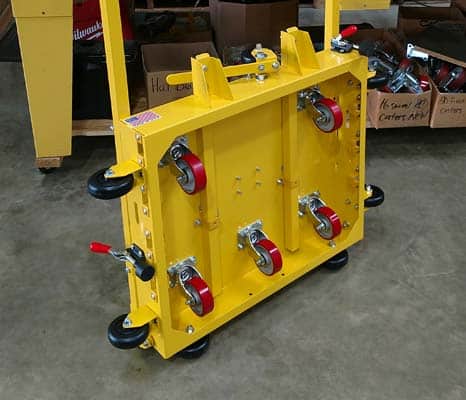
Getting a large door assembly onto a cart is only part of the problem. You still have to maneuver it through the facility.
The Scoop Dolly uses omnidirectional casters, allowing the load to move in multiple directions. That gives the operator more flexibility when navigating around equipment, racks, staging areas and other obstacles.
Instead of relying entirely on wide turns like a traditional fixed-wheel cart, the operator can make smaller positioning adjustments and move the door assembly laterally when necessary.
For applications where straight-line tracking is especially important, the Scoop Dolly Directional Wheel for improved straight-line control can be added to help guide heavy loads while pushing them forward.
Built for Tall, Heavy and Oversized Loads
The standard Scoop Dolly is designed for loads approximately 3 to 12 feet tall and has an 800-pound load capacity. An optional heavy-duty weight upgrade increases capacity to 1,000 pounds.

That makes the dolly suitable for many door and window assemblies, but unusually large units may need additional support. Saw Trax offers accessories specifically for taller and wider materials.
- Vertical extension posts for supporting taller door and window units extend the vertical support beyond 8 feet.
- Horizontal support extensions for door assemblies 8 feet wide or more provide additional support for extra-wide loads.
- The 72-inch Scoop Dolly lip for oversized doors and panels provides a wider loading surface for large door and window assemblies.
This ability to configure the dolly around the load is important because large door assemblies can vary considerably in width, height and weight.
Less Lifting, More Leverage
One of the main advantages of the Scoop Dolly is what the employee does not have to do.
Instead of relying primarily on lifting strength to place a large door assembly onto a cart, the Scoop Dolly is designed around leverage. The scoop slides under the load while the dolly remains on the floor, and the assembly is then tilted back against the support structure.
For operations that regularly manufacture, stage, ship or handle oversized door assemblies, reducing the amount of manual lifting involved can help reduce worker fatigue while also improving material handling efficiency.
It can also reduce the need to pull several employees away from other tasks simply because one large door unit needs to be repositioned.
Moving Quad Door Sets Through Loading Docks and Trucks
Large door assemblies do not always stay inside the warehouse. They may also need to move between staging areas, loading docks and freight trucks.
For those transitions, Saw Trax offers Dock Transition Wheels for moving a Scoop Dolly across loading dock transitions and ramps. The additional wheel system helps the dolly travel across changes in floor height that can otherwise be difficult for standard casters.

If a door assembly needs to be loaded into or removed from a truck without a cargo ramp or loading dock, Scoop Dolly Forklift Channels for loading doors and windows into trucks give a forklift a designated way to lift the dolly and its load.
Is the Scoop Dolly the Best Way to Move a Quad Door Set?
For many indoor manufacturing, warehouse and distribution applications involving a large assembled door unit, the Scoop Dolly is specifically designed around the problems these loads create.
It combines several capabilities that matter when moving a quad door set:
- Scoop loading: Reduces the need to lift the entire assembly onto a cart.
- Adjustable tilt positioning: Helps position the center of gravity over the dolly.
- Omnidirectional casters: Allow large loads to be repositioned and maneuvered more easily.
- 800-pound standard capacity: With an optional upgrade to 1,000 pounds.
- Support for tall loads: Designed for loads approximately 3 to 12 feet tall.
- Expandable support: Optional vertical and horizontal extensions accommodate unusually tall or wide assemblies.
Most importantly, the Scoop Dolly was designed around a problem that goes beyond simple weight. It is meant for objects that are large, tall, bulky and difficult to handle.
That describes a big quad door set very well.
Move Large Door Assemblies With Less Lifting
Whether you are moving quad door sets, fully framed entry doors, window assemblies or other oversized millwork, the right material handling equipment can make a difficult job considerably easier to manage.
The Scoop Dolly is part of Saw Trax’s broader line of industrial carts and dollies for moving doors, windows and oversized materials, with designs intended to improve material handling efficiency while reducing unnecessary lifting.
When the question is “What is the best method for moving a big quad door set?”, the Scoop Dolly provides a purpose-built answer: get underneath the load, use leverage to position it, and roll the entire assembly where it needs to go.
